
Arch Linux makes Linux fun to use again.
It’s been a month since I have installed Arch Linux on my workstation and I thought I would talk about this Linux distribution a bit. Arch Linux is pretty much all the rage these days in the world of Linux distributions. If we are to believe the famous Distrowatch stats that were recently published and compared with the data of 2008, Arch Linux is the fastest growing Linux distribution these days. It gained quite many users, probably at the expense of distributions like Gentoo, yet it is not usually considered to be an “user-friendly” distribution. I will briefly outline what have been, and what is, my experience with Arch, and I believe I am going to stick with this particular flavor for a very long time.
I have tested several Linux distributions in the past years, starting with Mandriva and using Debian, Fedora, Suse, Ubuntu, while having installed Linux several times on my family and friends’ computers. You can read in this previous post of mine that while my “usual” distribution was Fedora I had some rough issues with the upgrade from Fedora 11 to Fedora 12, and that prompted me, after some adventures, to install Ubuntu. Well, I stayed about two weeks with Ubuntu, in the end. There was nothing wrong with it, it’s a beautiful distribution (except for the buggy packaging of Claws Mail, my default email client) everything runs just fine, drivers, 3D, Second Life, third party repositories, etc. But I was somewhat dissatisfied for egotistic reasons: I have been using Linux, as a desktop user, ever since 2001 (with some intervals with OS X) and although I don’t want to fiddle too much with the system, I like to customize it, to tweak it and to gain a technical knowledge of it. So when I found myself at a barcamp in Paris in December sitting next to someone who was less technical than I am using Ubuntu on her desktop, I got the personal, but awful epiphany that I was, just like everyone else, using the Windows XP of the distros. Sorry for this Canonical, sorry for this, Nick, it’s actually a major achievement to be thought of a Windows XP in your industry, but I’m perhaps too much of a twisted, egotistic nerd.
I don’t exactly know how I came to Arch Linux. I guess I was reading an article about it, then in one evening I documented myself, and what attracted me to it was the different packagine, the style, and also the fact that hardware was not a problem (wireless, video card, etc.) So I gave it a try, and the first impression I got, besides thinking I was back in 2001, was that it all made sense. What I mean is that once you have gone past the two minutes of emotional intensity (oh my God, the screen went black and these small white letters are being typed by an invisble hand!) and that you… read what your options are, it’s not that difficult for you to install and configure the system. In a sense, I would even say that since Arch Linux installs only what you want it to install, there is no instant clutter on your desktop. I often found out that I spent more time configuring my desktop by pulling out what I did not need and replacing it sometimes by other programs than the actual time I would be spending installing the system. In this regard, Arch Linux, whith some rough edges at the beginning, was a different experience. You get what you want and it’s all right if you don’t manage it the first time, there is plenty of a well organized documentation for Arch available on their wiki or even as a book. Documentation is clear, well written, and asking on the forums really helps.
In the process, I leaned, or relearned a lot of things. From the point of view of the desktop user, Arch Linux can be configured by using pacman (the package manager available in command line and graphically, through Shaman, a direct competitor to Synaptic), editing the rc.conf file in the /etc/directory (it’s all human readable, don’t worry), and starting or stopping services through /etc/rc.d . You don’t really need to go beyond that on a daily, weekly or even monthly basis. Package Management is quite interesting. Updates, even when you are not using the testing branch of the distribution, are not updates that are pushed at you and that you have to digest. Arch Linux is a rolling release, which means that it’s a distribution without release. You install a base system (itself on a rolling release) and it “morphs” according to your needs without any need to reinstall. That’s the theory, because I think one would need to reinstall it every few years, unless everything runs perfectly. So this rolling release mode makes it possible for you to use the latest versions of software without the need to wait for the next big release or the issuing of a backport. But it depens on you to understand what you are about to upgrade: Going from Firefox 3.5.6 to 3.5.7 should be no problem, but changing the version of nvidia modules is a different game. That’s why it is recommended to check out announcements and the Arch forums each time you want to update your system.
Package management, however, does not stop there. Arch packages (which are really tarballs of the binary versions of the software compiled from the source) are vanilla packages (except in some very rare instances) but the team maintaining the core and extra repositories is too small. That’s why you can have access to the community repositories and the Arch User repositories. These sources are places where the community contributes packages it has compiled using Arch’s own build system, the ABS. That’s where you can find many interesting software. It is also easy for you to compile any software provided you have the source, and upload it in the distribution.
My big surprize was perhaps the fact that Arch works. It is a system that actually works. By this I mean that there is no “tweaking around” solution. It works and the reason why it works makes sense on Linux, not on one specific distribution only. All this , in the end, brought a lot of fun in using Linux for me. I am not suggesting Arch is for everyone, but if you want to try a rock-solid distribution that’s blazingly fast and in the end, pretty easy to configure, you should give a try to Arch Linux. It’s a good way to start 2010!
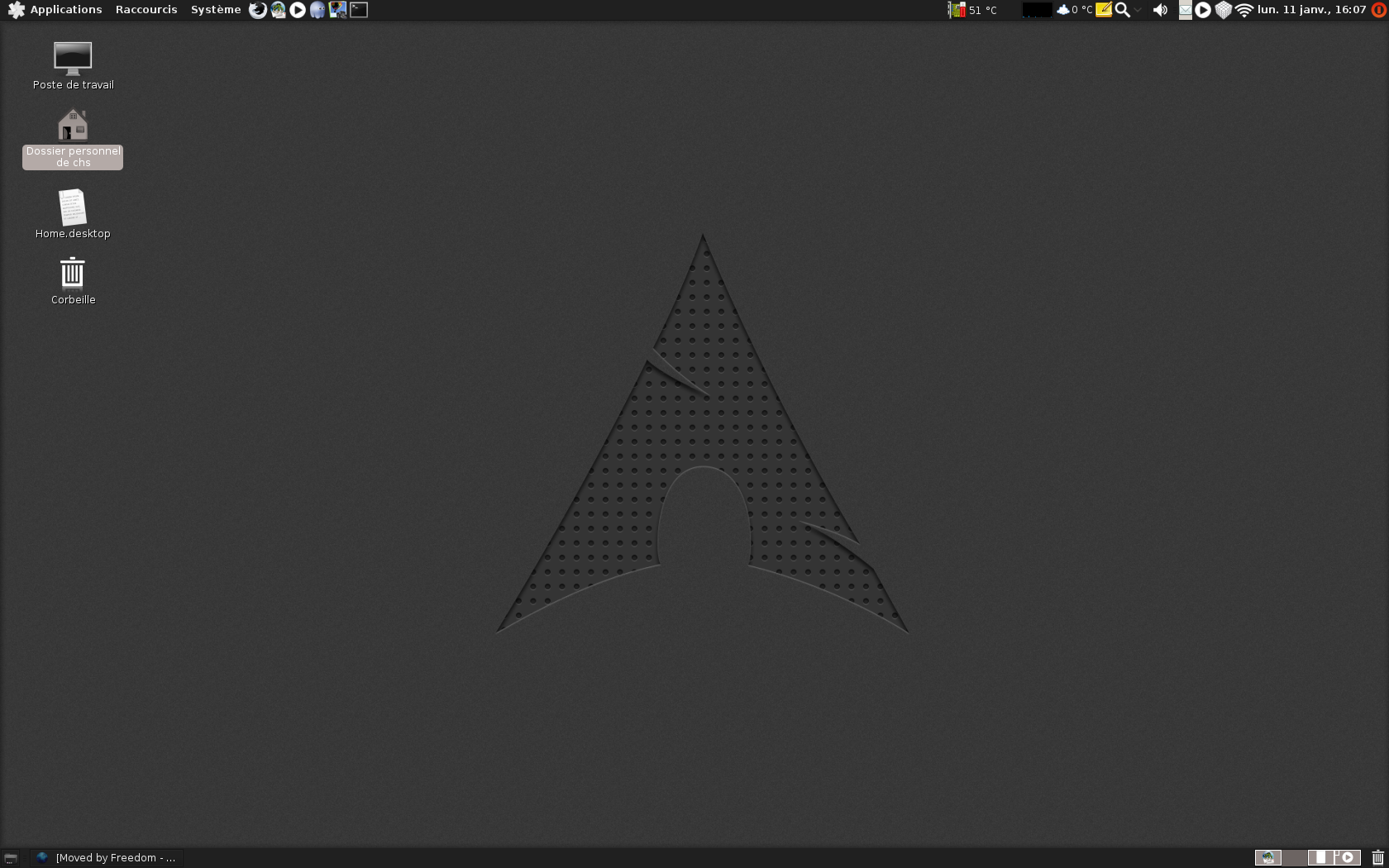
Below is a screenshot of my desktop under Gnome.


Ive tried installing arch 9 times now.. either have xorg issues, kernel panic issues, black screen issues, keyboard and mouse dont work issues, repos say packages dont exist, even though i’m typing it verbatim from the 81 page install manual i printed out myself.. one thing after another..
I guess like some rude people in the irc archroom stated “perhaps you dont DESERVE arch”.. perhaps not.. until they dummy down their install manual, give you a gui solution with as much functionality as command line (which as GREAT as linux is, I know this can be done without belittling those of us that could really use just a LITTLE bit of hand holding), until then Ill stick with my lesser of a distro (not a REAL linux users distro, told this in that same chatroom), Kubuntu 9.10… until this egotism, and these people that were “born” knowing everything about linux, stop their belittling of the rest of us, it’ll NEVER be the YEAR OF THE LINUX DESKTOP. just wish Pclinuxos (a GREAT rolling release distro) was 64bit, if it were, I’d be using that instead.. I’m sure arch is an AWESOME distro, (i’m told that everytime I ask for help, along with “read the wiki”)but so far it’s not for me..
Excellent review. I moved to Arch as well from Ubuntu. I love the rolling release model, never having to do the major 6 month update crap again.
Decided i hated Gnome and installed KDE and Enlightenement DR17 windows managers. Very responsive, my systems are much more snappier than my Ubuntu installs. Not sure why that is, probably due to me installing only what i need, and not what somebody else thinks i need from the start.
The biggest sell for me is the rolling release model and bleeding edge packages. Pacman is pure awesomeness, and the ABS is pure genius, allowing Arch to have a great variety of packages available on par with the much bigger organization of Canonical.
Just shows you bigger isn’t always better. IMO if you can read, you can install Arch without too much trouble.
great article, arch is by far the best. Super fast.
@Brad:
try the Chakra Linux Live CD, and you’ll end up with Arch. It’s even simpler than the old days where people were ending up installing Debian through Knoppix
Great post.
I’ve been following a similar path, and share most of what you say. I come from 3 years of Ubuntu, and like you, I have nothing against it, but it was getting boring…I needed a little challenge and a more bear bone/close to the metal distribution, which I found in arch.
What I love in arch is:
- the rolling release model
- yes, pacman of course
- the control it gives me over my machine
- AUR & ABS
- the community and documentation
- as you say, it makes linux fun to use again
Mandatory question: what’s your wallpaper and icons? They look nice
@FreeBooteR:
My install of KDE Arch is dying on its ar*e. Everything is so sluggish. So, I decided to install Gnome and now I have my super zippy Arch back.
@Brad:
Arch can be painful if the install doesn’t go smoothly. Either do what Charles suggests with Chakra, or use Arch’s extremely helpful Wiki or just ask in the Arch Forums. They both were life savers for me when I started with Arch a few years back.
Nice review; reading it, i was almost doing _s/arch/sidux/g_. Never used Arch, but the review made me curious. I am happy user of sidux though; debian, kde, super fast, great support; it would take a lot to make me change but, why not trying Arch too?
It is nice to see 2 rolling distros of this quality close to the spirit of Linux.
@frigault: controls and window borders: Sonar-Dust icons: DrakFire evolution. Wallpaper: don’t remember. It was either on archlinux.fr or .org, or even perhaps on gnome-look.org …
@jyp: I never tried sidux, but, how is it different from, say, Ubuntu?
@Charles
sidux is a rolling distro; it is debian sid (unstable) made rock solid by the sidux team. I am not a geek but I have been using it for roughly 2 years on many machines and I cannot say anything else than “it’s a GREAT distro”. Have a look at sidux.com.
Ubuntu (Kubuntu), like many, have been there in the beginning; but no comparison possible. The closest to sidux, imho would be Arch. But Arch unfortunately (just my opinion) is not Debian; sidux is.
This article made me wanna try Arch again on a separate partition. I became quite frustrated with Linux recently even though I use Ubuntu. There’s always something that doesn’t quite work and it’s usually stuff that’s considered basic like audio playback. I’ve started wishing for a Mac which frankly I actually may get as soon as possible.
But then again while it requires some initial work Arch may actually be a better experience overall because of it’s underlying simplicity and control. There are not so many layers of abstraction that could all add up to some breakage.
But I dunno, most of all I’m just curious about it at this point.
Thanks for a nice post.
@libervisco:
So of course, we may start from different points, but fundamentally, I’m someone who is moving away from Macs despite all the good stuff they offer…
It’s funny because I still use a Mac as a laptop. I’m very happy with the mac hardware, the OS is beautiful, but it’s a commercial trap. Once you bought one Mac then you end up with an ipod. And for everything Multimedia, Mac is just a no-go for me. In the end I’m choosing to go back to Linux, which is done for my main workstation, and my phone which runs Android. Now all my music is on .ogg and .mp3 and nobody is telling me how I should listen to it
@Brad
I personally hate the Arch community for that (and their insufferable KISS attitude where it’s stupid to have such an attitude.) Basically here’s where I stand. A distro should work for you. If it doesn’t use one that does. If you don’t like Arch’s way of doing things, go to one you do like. If Arch’s way of doing things is too hard for you to do, but if Kubuntu’s methods work for you, use that. The reason a lot of us use Linux is for the choices. Is Arch any better or worse then Kubuntu? I’d say no. Arch may do some things well (PKGBUILD’s are great) but doesn’t do other things as well (Do most users need the development headers? Probably not, so splitting packages makes sense here. Do users sometimes want developer documentation that Arch sends to /dev/null on build by default? Yeah, I would like to have developer documentation for times that I may not have internet access.) Basically, you should try to pick the distro that fits your needs the best. If Arch doesn’t fit those (doesn’t work, don’t like it’s methods, whatever) don’t use it.
I love to help promote Linux, but I rarely ever promote the distros I use because I tend to use distros targeted at power users. Unless I’m talking to someone which I think would be interesting in that. Power users I tend to recommend Arch, Gentoo (if you’re into that type of thing, you know, compiling most everything, Sourcemage might be interesting too because it’s source based), Debian (really not that hard, but it’s not as easy as *buntu’s), Slackware, or even a BSD (because lets face it, BSD’s are pretty cool too.) All in all though, most people will just want something that works quickly and easily, and the *buntus, OpenSUSE, Fedora, and a few others are great for that. If your needs are more specialized, choose from one of the other couple hundred distributions.
I got most of the way through an Arch install a year or so ago. Then went back to Ubuntu. Feeling like I *should* be able to install Arch, I tried again, but unfortunately – combination of work and two small kids – by the time I sat down to my laptop my brain was fried and I kept putting off setting up the X server. Then my wife started nagging that she wanted a working computer (my laptop is our house’s only pc) so I just nuked my partial installation and put Ubuntu back on again. My wife is happy, but I have this nagging feeling that I chickened out, and that I should maybe have just another go at it…